
Fundamentals
What GFRC is, where it comes from and why it suits furniture making.
Material & Tech
Mineral, thin-walled, weather-resistant all year round. Here we explain what GFRC does, how it differs from traditional concrete — and how Elementi turns it into an integrated material system.
Material
Glass fibre reinforced concrete (GFRC)
Applications
Indoor and outdoor · furniture · fire features · architectural surfaces
Development & production
Elementi · own manufacturing and in-house R&D lab
In this section
Material & Tech is built as a knowledge centre. Six topics that build on each other take you deeper step by step — from the technological foundations and the quality standards to getting the material right in your own spaces.
What GFRC is, where it comes from and why it suits furniture making.
GFRC next to wood, metal, plastic, traditional concrete and MgO.
What separates good GFRC furniture — and how Elementi manufactures.
Textures, colours, finishing and the material aesthetic of ELEMENTI GFRC.
Indoors and outdoors, everyday durability, cleaning and maintenance.
The 6R philosophy: material efficiency, longevity and circularity.
GFRC stands for Glass Fibre Reinforced Concrete. Fine glass fibres are mixed into the concrete. They raise tensile strength and reduce the material's tendency to crack.
The material started in façade construction and landscape architecture — wherever high stability at the lowest possible weight is what matters. In North America it has long since established itself in furniture too, above all in high-quality outdoor furniture and fire features. In Europe that development is comparatively new.
In the German-speaking market Elementi introduced the term “GF-Beton” as a plain-language name for GFRC.
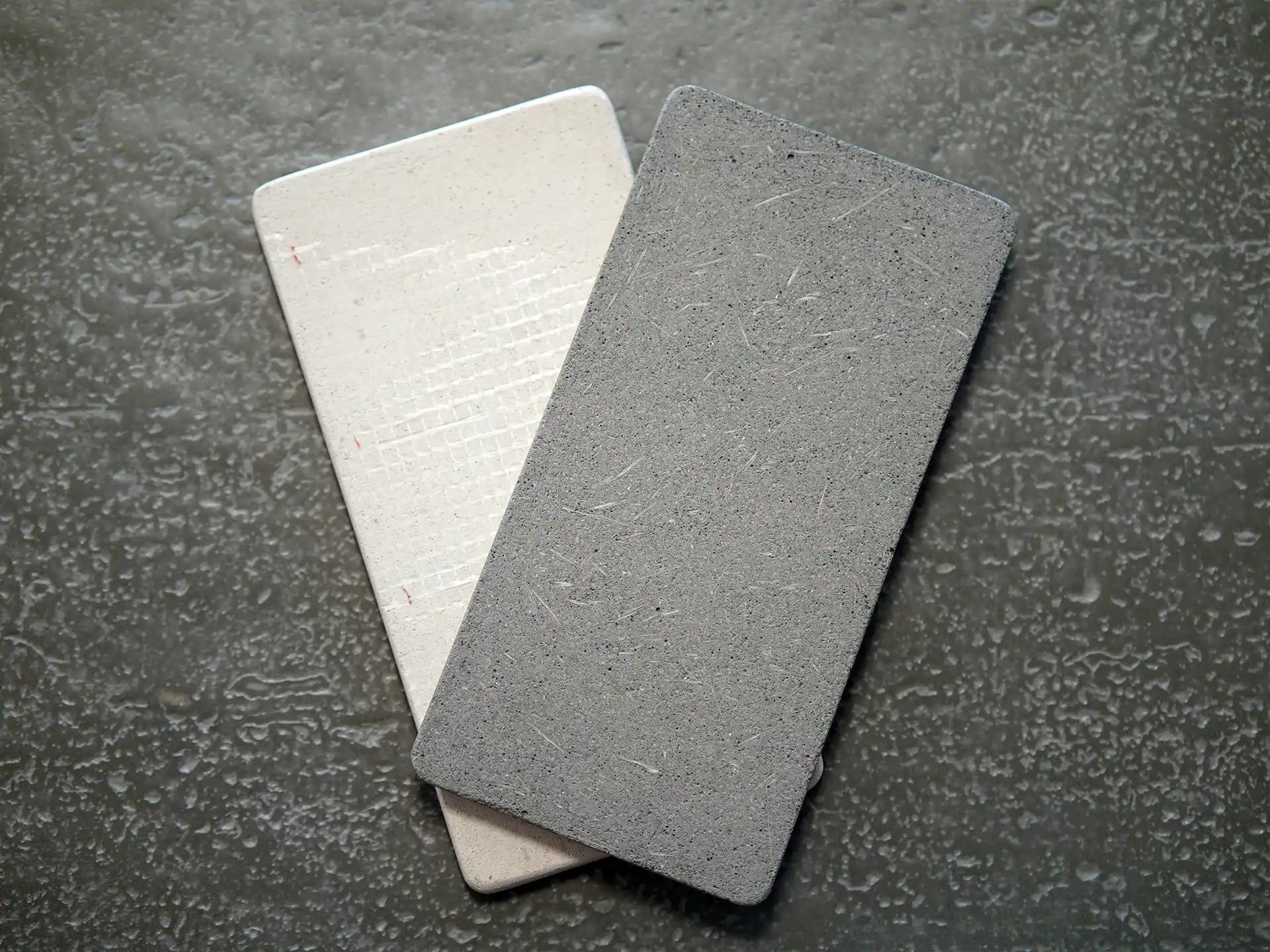
The material properties of GFRC open up possibilities that traditional concrete can only deliver to a limited degree — especially in furniture and outdoor applications.
Glass fibre reinforcement allows components to be cast much thinner — less weight without losing structural stability. Up to 50–80% lighter than traditional concrete.
Unaffected by frost, UV radiation and moisture. Suitable for year-round outdoor use — including through changing seasons.
More precise and more versatile than conventional concrete: complex shapes, fine edges and slim structures — without losing stability.
High flexural strength, crack resistance and a sealed surface that in everyday use can often be cleaned with a damp cloth.
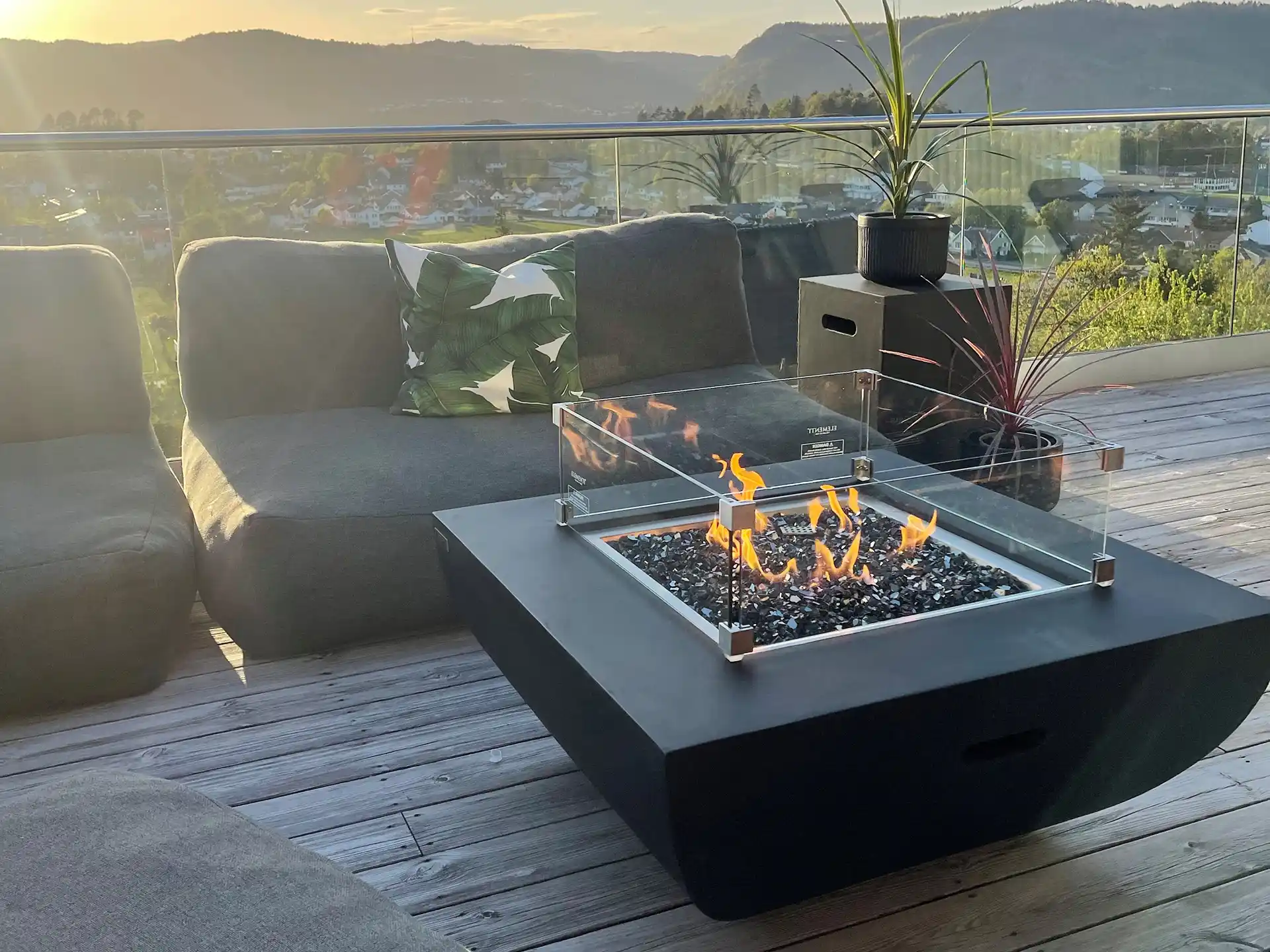
Hard numbers instead of material promises — the basis for tenders, planning and specification.
| Test criterion | Result | Relevance in application |
|---|---|---|
| Bulk density | approx. 1.70 g/cm³ | Comparatively low weight at high stability |
| Flexural strength (MOR) | Ø 16.7 MPa | High structural load capacity, even in slim components |
| Water resistance | No droplet formation after 24 h of water exposure | Reduced moisture uptake outdoors |
| Freeze-thaw cycling | Stable strength values across load cycles (MOR retention > 90% after load cycles) | Suitable for long-term outdoor use, including frost |
| Impact resistance | High resistance to point loads | Reduced risk of chipping in everyday use |
| UV resistance | No fading, no cracking | Colour stability over years |
| Stain resistance | Red wine, tea, cola, soy sauce, vinegar — a damp cloth is usually enough | Mineral surfaces that stand up to everyday life |
| Repairability | Same-colour sanding without visible transitions | Repair instead of replacement |
| Fire behaviour | Non-combustible (A1) | Safety indoors and outdoors |
Data is based on measurements and analyses by the ELEMENTI material laboratory. Full technical data sheet (TDS) on request.
Request technical dataThere is no universally “best” material — the choice depends on the application and the requirements. Side by side, it becomes clear where GFRC plays to its strengths.
| Material | Weight | Weather | Care | Forming | Character in use |
|---|---|---|---|---|---|
| Wood | ●●●○○ | ●●○○○ | ○○○○○ | ●●●●○ | Natural look, but care-intensive: oiling or painting, movement, cracking, warping. |
| Metal | ●●●○○ | ●●●○○ | ●●●●○ | ●●●○○ | Stable and durable, but heats up strongly in the sun; corrosion risk depending on the coating. |
| Plastic | ●●●●● | ●●○○○ | ●●●●○ | ●●●○○ | Light and inexpensive, yet limited in stability, longevity and perceived value; UV ageing possible. |
| MgO-based | ●●●●○ | ●●●○○ | ●●●○○ | ●●●○○ | Lighter than traditional concrete, flexible shapes — structural density and frost resistance depend on the process. |
| Traditional concrete | ○○○○○ | ●●●●● | ●●●●○ | ●●○○○ | Very stable and weather-resistant, but heavy and strongly limited in form. |
| GFRC | ●●●●○ | ●●●●● | ●●●●● | ●●●●● | Combines high stability with low weight, great freedom of form and a low-maintenance mineral surface. |
Assessment is qualitative, for furniture and outdoor applications. ●●●●● = very advantageous, ○ = less advantageous.
Both material systems are used for similar applications — but they differ clearly in structure, manufacturing and long-term behaviour.
| Property | MgO-based materials | GFRC |
|---|---|---|
| Material structure | Often a layer-based build-up | Homogeneous, fibre-reinforced composite structure |
| Manufacturing | Often hand-formed processes | Controlled spray or casting processes |
| Fibre structure | Mostly within individual layers | Multidirectional reinforcement |
| Material density | Partially higher porosity | High structural density |
| Moisture resistance | Depends on processing and environmental exposure | High resistance to frost and moisture |
| Frost resistance | Partly material-dependent | Suitable for long-term outdoor use |
| Forming | More limited with complex shapes | High design flexibility |
| Long-term stability | Depends on build-up and processing | High structural load capacity |
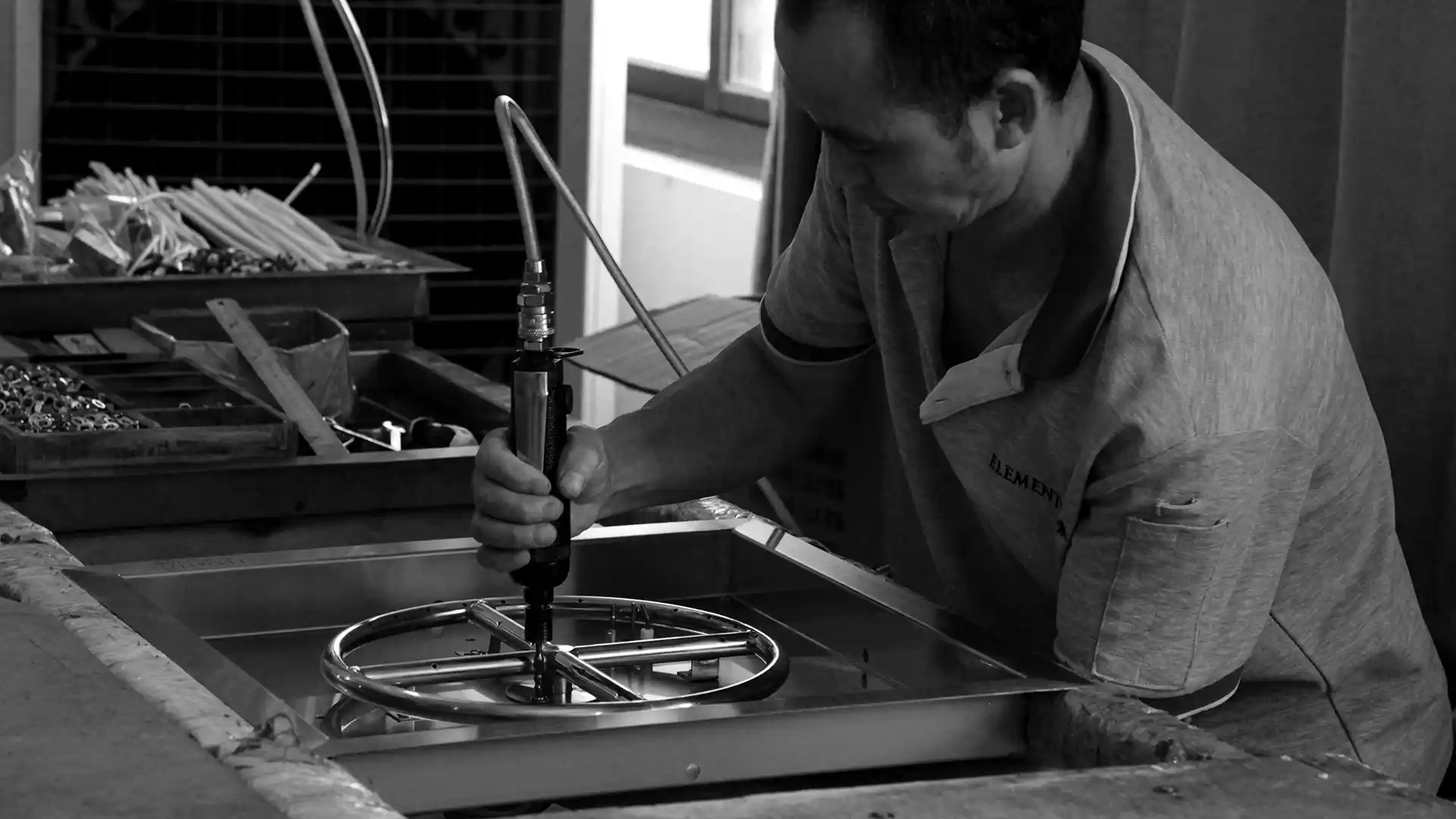
Glass fibre reinforced concrete is offered on the market in very different qualities. Not every GFRC mix reaches the structural density, dimensional accuracy and longevity that define an ELEMENTI piece.
Where conventional GFRC is still often shaped by hand in layers, we manufacture ELEMENTI GFRC in a precise, computer-controlled spray process. The result: a homogeneous, void-free composite structure with optimal fibre distribution.
Our exact process control gives ELEMENTI GFRC components an exceptionally high structural density. That allows extremely thin walls at outstanding stability — lightweight design without compromising load capacity.
Protection for ELEMENTI GFRC goes far beyond simple pigmentation. Our multi-layer surface and sealing system, developed in our in-house R&D lab, guarantees high resistance to moisture, stubborn stains and everyday wear — even in light mineral finishes.
Lower-grade GFRC furniture often suffers from inconsistent material thicknesses. The architecture of ELEMENTI GFRC is based on structurally optimised, load-bearing shapes that combine lightness with extreme torsional rigidity, efficiently and durably.
| Worauf zu achten ist | |
|---|---|
| Manufacturing process | Spray process (controlled, dense) or hand-formed (layer-based)? |
| Fibre direction | Multidirectionally bound, or only in individual layers? |
| Wall thicknesses | Precise and even — or strongly varying? |
| Surface protection | Multi-layer sealed — or merely pigmented? |
| Stain behaviour | How does the surface react to red wine, oil, coffee? |
| Repairability | Colour through the section — can it be sanded without a repair line? |
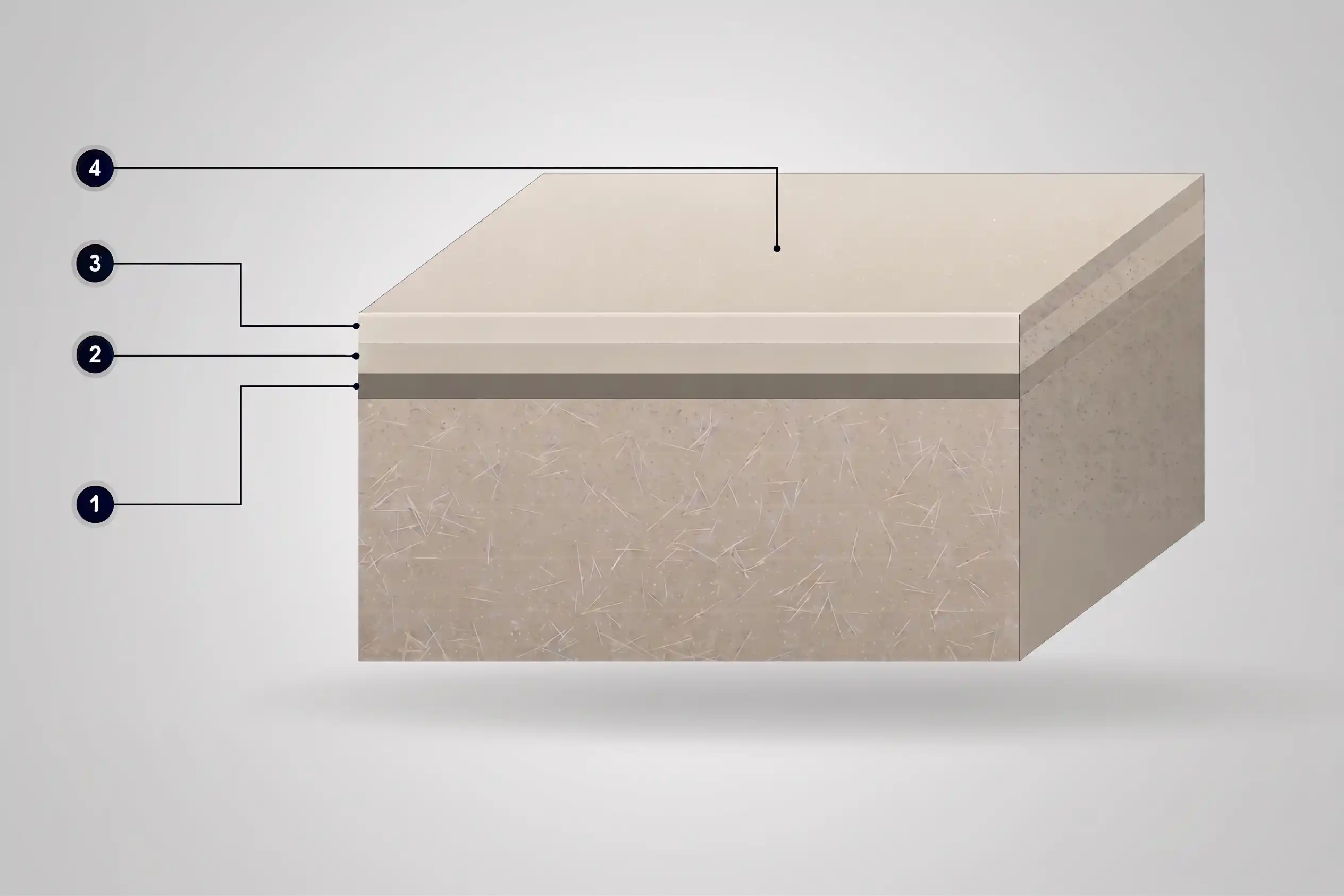
Elementi does not treat GFRC as a single material but as a complete technological system of material, structure, surface treatment and design.
| Layer build-up – fire features | Description |
|---|---|
| 1 GFRC core | Multi-layer spray process: dense, homogeneous structure with reduced porosity, glass fibres embedded in multiple directions. |
| 2 Bonding primer | Stable bond between the material and the protective system; supports the integration of the individual layers. |
| 3 Protective layer | Water-based and nano-optimised: reduces moisture and dirt, high UV and temperature resistance. |
| 4 Matte seal | Very low light reflection, calm mineral appearance, additional protection against weather and ageing. |
In addition, a specially developed, patented material formulation is used, designed for high thermal load. The surfaces keep their structural stability even under strong temperature swings — decisive for fire features and outdoor fireplaces.
On table and furniture surfaces the build-up is extended by an oil-repellent protective layer. It reduces the uptake of oil-based substances and supports natural self-cleaning. Matte seals keep reflection low and the feel pleasantly natural.
Hand-led processing creates natural textures with fine colour transitions and mineral depth. Instead of an industrial concrete look, the emphasis is on soft transitions, flowing lines and organic contours — a design language that brings calm and lightness to the material.
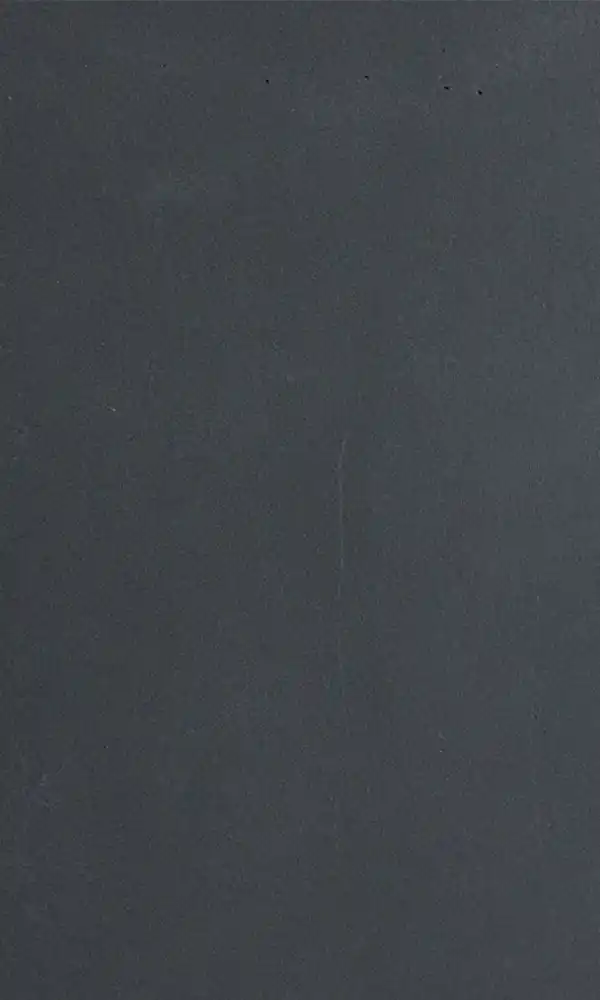
The foundation of the ELEMENTI material system is 4 base colours that run through the section. The pigment is bound directly into the GFRC mass — for colour depth throughout the material rather than a surface coat of paint.
The interplay of these 4 base colours, expressive natural textures and precise surface finishing is what creates the unique variety of our range. To reproduce complex natural structures with complete authenticity, we use specially developed coating systems and precise water transfer printing by ELEMENTI on selected textures.



| Pillar | Technology & concept | Customer benefit |
|---|---|---|
| 01 / 4 base colours | Cast through the section: the pigment is fully bound into the GFRC matrix — with no subsequent colour coating. | Colour depth throughout: no chipping, and minor damage can be sanded out invisibly. |
| 02 / Natural textures | Authentic reproduction: from finely structured stone looks to organic grain. For complex textures we use specially developed coating systems and precise water transfer printing to render nature realistically to the eye and to the touch. | Wide-ranging aesthetics: stone and wood looks with the durability and lightness of GFRC. |
| 03 / Surface finishing | Handcrafted finish & protection: acid wash, fine sanding, blasting and our multi-layer matte sealing system. | Tactile feel & protection: built-in stain protection on a natural, low-reflection mineral surface. |
48 surfaces
Each finish shows its name, what it is and where it is used.
5 surfaces
5 surfaces
3 surfaces
3 surfaces
3 surfaces
4 surfaces
6 surfaces
19 surfaces
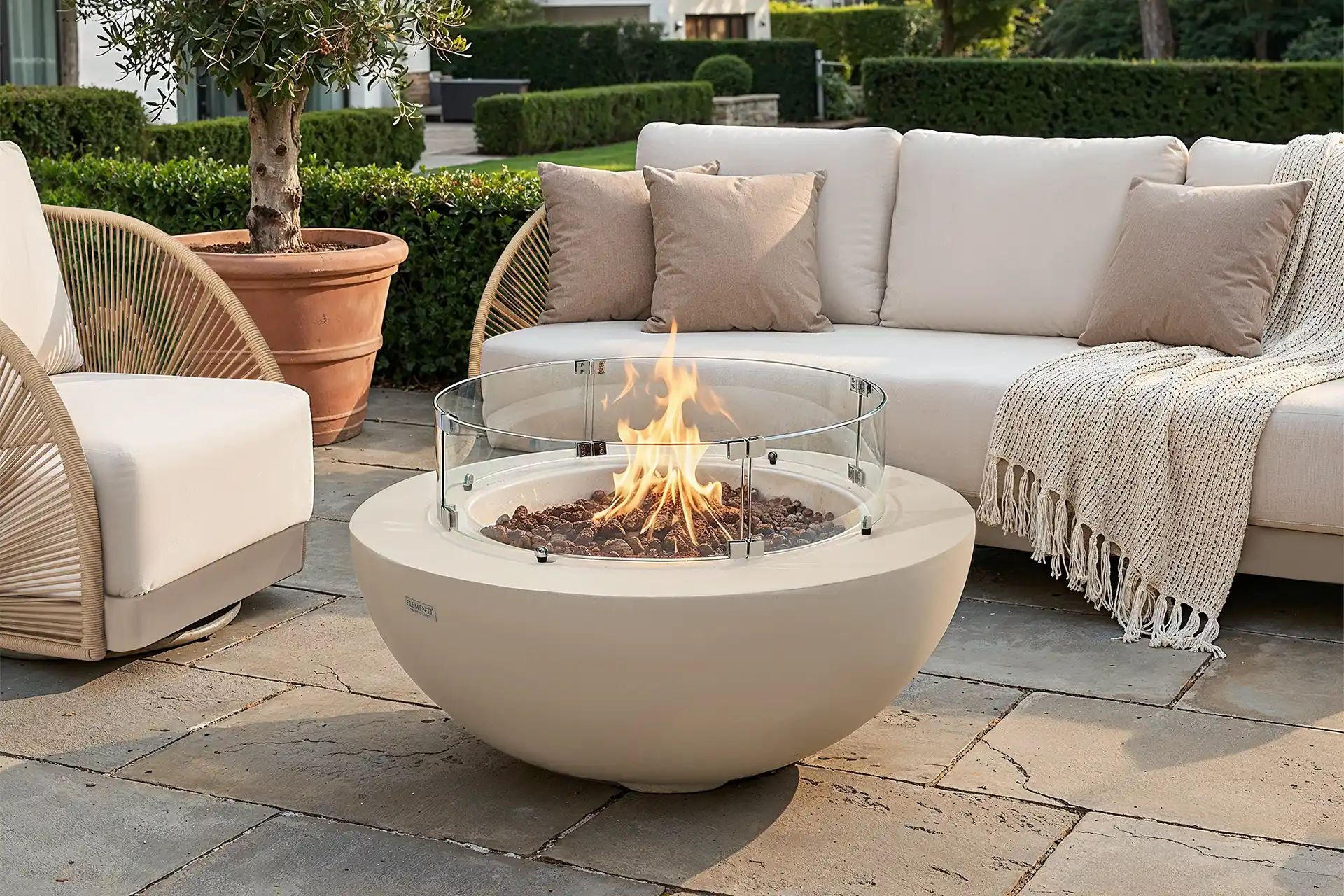
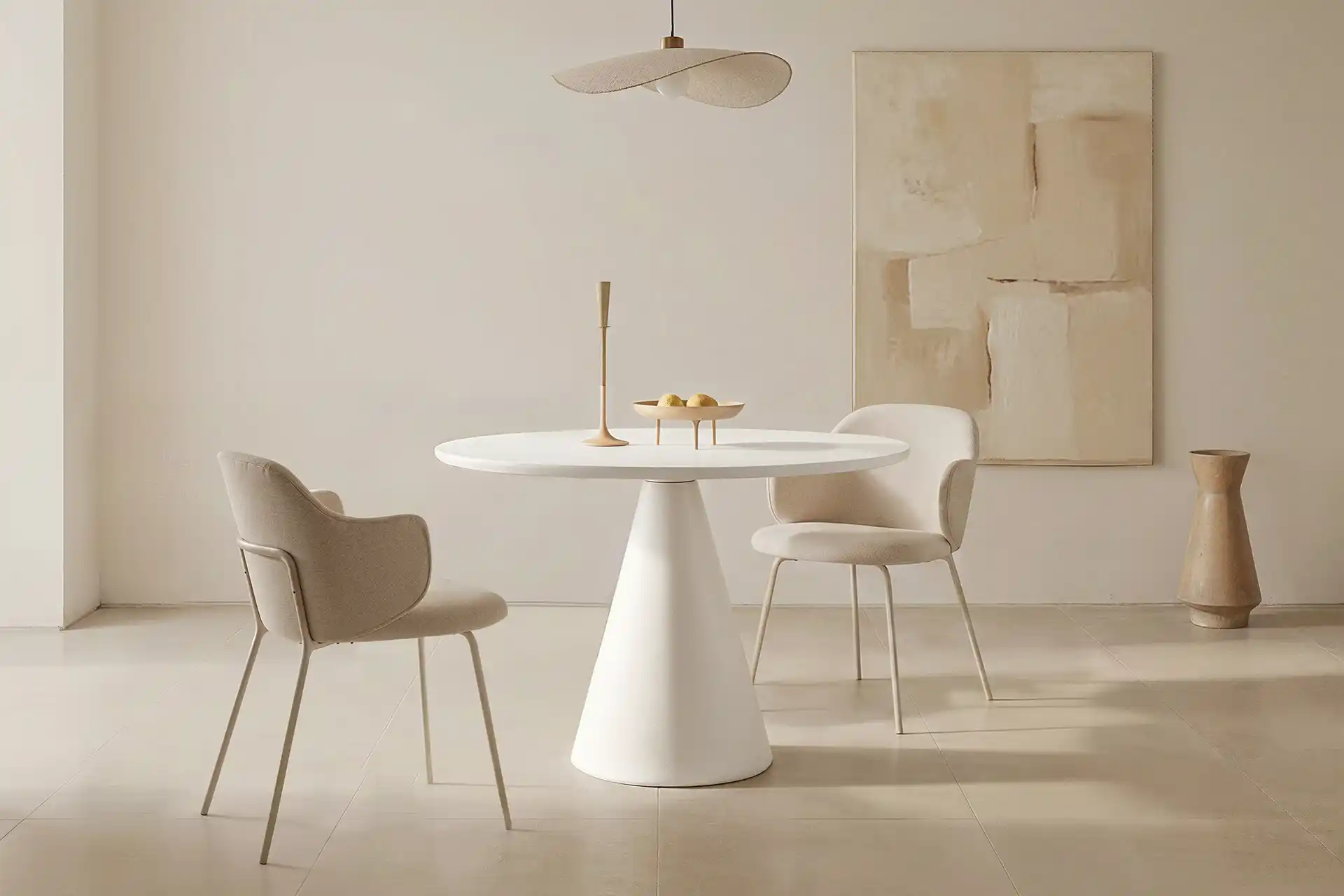
GFRC suits indoor and outdoor areas equally and makes one continuous design language possible across different usage scenarios.
| Area | Scenario | Description |
|---|---|---|
| Outdoors | Fire and water | Gas fire features and water-related design elements as the focal points of a garden or terrace scheme. |
| Outdoors | Dining and lounge zones | Modular table and seating systems for terraces, pools and hospitality areas. |
| Indoors | Living and contract | A seamless link between indoors and outdoors through the same material language. |
| Indoors | Wall, floor and spa | Wall cladding, surface elements and applications in bath and spa areas. |
At Elementi, sustainability is not an added brand value but the result of material structure, manufacturing technology and how the material performs in use. The 6R model describes the whole lifecycle — from material optimisation to return into the cycle.
| R | Principle | Description |
|---|---|---|
| Reduce | Material & resource efficiency | Wall thicknesses from approx. 12–25 mm without loss of stability; up to 50–80% weight saving compared with traditional concrete — noticeable in transport energy and logistics CO₂ emissions. |
| Resilience | Service life & stability | Flexural strength (MOR) of approx. 16.7 MPa and proven freeze-thaw stability (approx. 17.4 MPa after cycles) — stable performance under changing environmental conditions. |
| Replace | Substitution of conventional materials | A mineral, low-emission material base instead of fossil plastics; no regular surface treatment as with wood, and minimised weather-related deformation. |
| Reuse | Continued functional use | Usable indoors and outdoors, and reusable when spatial requirements change — a longer life across different contexts. |
| Repair | Maintenance & material retention | Local surface damage can be repaired with material-compatible processes instead of replacing the whole piece. |
| Recycle | Return into the material cycle | As a mineral composite it can be mechanically crushed and reused as recycled material in downstream construction or infrastructure processes. |
| Question | Answer |
|---|---|
| What do GF-Beton and GFRC mean? | GFRC stands for Glass Fibre Reinforced Concrete. Fine glass fibres are mixed into the concrete, raising tensile strength while reducing the tendency to crack. “GF-Beton” is the term Elementi introduced in the German-speaking market. |
| Is GFRC weather-resistant? | Yes. GFRC is fundamentally unaffected by frost, UV radiation and moisture. In freeze-thaw testing the strength values stay stable across load cycles, which makes the material suitable for year-round outdoor use. |
| How heavy is GFRC furniture? | Bulk density is approx. 1.70 g/cm³. Glass fibre reinforcement allows components to be cast much thinner — up to 50–80% lighter than comparable components in traditional concrete. |
| How do I care for GFRC surfaces? | High-quality sealed GFRC surfaces can in many everyday cases be cleaned with a damp cloth. For typical household substances such as red wine, tea, cola, soy sauce or vinegar, water is often enough; pigmented residues can be removed with mild cleaning agents. |
| Can GFRC stay outside in winter? | Yes. Proven freeze-thaw stability makes the material suitable for permanent outdoor use — including frost and changing seasons. |
| What is the difference between GFRC and MgO? | MgO-based materials are often layer-based and hand-formed; structural density and resistance to moisture and frost depend heavily on processing and build-up. GFRC, by contrast, is produced in controlled spray or casting processes with multidirectional fibre reinforcement and reaches a homogeneous, dense structure with high long-term stability. |
| Is GFRC fire-resistant? | GFRC is non-combustible (fire class A1). For fire features, a specially developed, patented material formulation with high thermal load capacity is used as well. |
| Can scratches or damage be repaired? | Because the colour runs through the entire section, minor damage can be sanded out in the same colour, without leaving a visible repair line. |
Next step
Request original Elementi samples, or have the technical data compiled for your project — for specification, tender and advice.